
Why you need Lala SEO
Free 4 minute read
Who it is for: Anyone whose goal is more traffic and better rankings.
You need Lala SEO because a search engine has to reach, read and trust a page before your content or your links can count for anything, and the faults that stop it are invisible from the front of a website. It runs 101 technical SEO checks, 48 of them requirements stated in Google's own documentation, and re-tests what it finds against your live pages.
Why it matters
You want more traffic and better positions. You have read the advice, perhaps written the content, and the numbers have not moved. What rarely gets said is that a search engine has to be able to reach a page, read it and trust it before any of that work counts — and the faults that stop it are invisible from the front of a website.
What to do
- Invisible blockers — a search engine can only rank what it can reach. A page blocked in robots.txt, or carrying a tag that asks search engines not to index it, earns nothing however good it is. Both are one-line mistakes, and both are common on sites that look perfectly healthy.
- Canonical and duplicate-content errors — it can only trust what is consistent. A canonical pointing at a redirect, two addresses serving the same page, a redirect chain, a mobile version with different content: each tells Google something different about the same page, and Google has to pick one.
- None of it shows on the page — it takes a crawl to find. Your pages look fine in a browser. These faults live in headers, meta tags, redirects and robots rules that a visitor never sees and a search engine always does.
- Pages that are empty until JavaScript fills them — what your server sends is not what Google reads. On a site built with React, Next.js or something like them, the HTML your server sends can carry no heading and almost no words; the browser assembles the page afterwards. We re-render those pages in a real browser before any check runs, so the title, headings, schema and word count we judge are the finished ones. We do this for the first 15 such pages in an audit, and the report names the rest as unchecked rather than marking them thin on HTML we know is incomplete.
- Findings checked against the live page — 101 checks, 48 of them from Google's documentation. Findings are re-fetched from your live site and confirmed before you are shown them, so you are not sent to fix something that is no longer there. We sample up to two pages per finding inside a time budget, and the report says which ones it reached and which it could not — it narrows false positives rather than pretending to abolish them.
- Instructions a developer can act on — in plain English. Not "optimise your canonical tags". The address, the fault, and what to put instead, in words you can paste into a ticket. The universal explanation of every rule is free; advice written about your own pages is metered, at 3 a month on the free plan.
What a technical SEO audit actually checks
A technical SEO audit asks three questions about each page on your site: can a search engine reach it, can it read what is on it, and can it tell which page to show when two of them look alike. It is not about your writing, your keywords or your links. Those matter — and not one of them counts for anything on a page Google was never able to index. This is the part of search engine optimisation that is pass or fail rather than a matter of judgement, which is why it is the part worth settling first.
The faults that never show in a browser
Your pages look fine, because none of these lives in the part of a page a person reads. A line in robots.txt that tells crawlers to stay out of a folder. A tag asking search engines not to index a page, left on after a staging site went live. A canonical tag pointing at an address that redirects somewhere else, so the page nominates a page that no longer exists. Two addresses serving the same content with nothing to say which is the real one. A page built in the browser by JavaScript, where the HTML your server sends carries no heading at all. We run 101 checks for faults of this kind, 48 of them requirements written in Google’s own documentation — and each of those findings links to the page it came from, so you can read the rule rather than take our word for it.
What an audit cannot tell you
No tool can predict a ranking, and one that offers to is promising something it has no way to deliver. We are not affiliated with Google and cannot see inside how it ranks pages. What an audit gives you is narrower and more useful than a prediction: the specific, checkable reasons a search engine might not be able to use a page, with the addresses attached. Fixing them is necessary. It is not sufficient on its own, and anybody who tells you otherwise is selling you something.
When to run one
Run an audit after anything structural — a redesign, a change of platform, a URL migration, an edit to robots.txt, a move to new hosting. That is when these faults get introduced, almost always by accident, and it is also the moment nobody is looking for them. Between those moments a periodic check is enough: a free audit costs nothing and you can run as many as you like. Every plan also re-crawls on a schedule and tells you what changed — every 30 days on Free, every 7 on Growth and Agency — so a fault introduced by a deploy is something you are told about rather than something you have to remember to go and look for.
What you get back
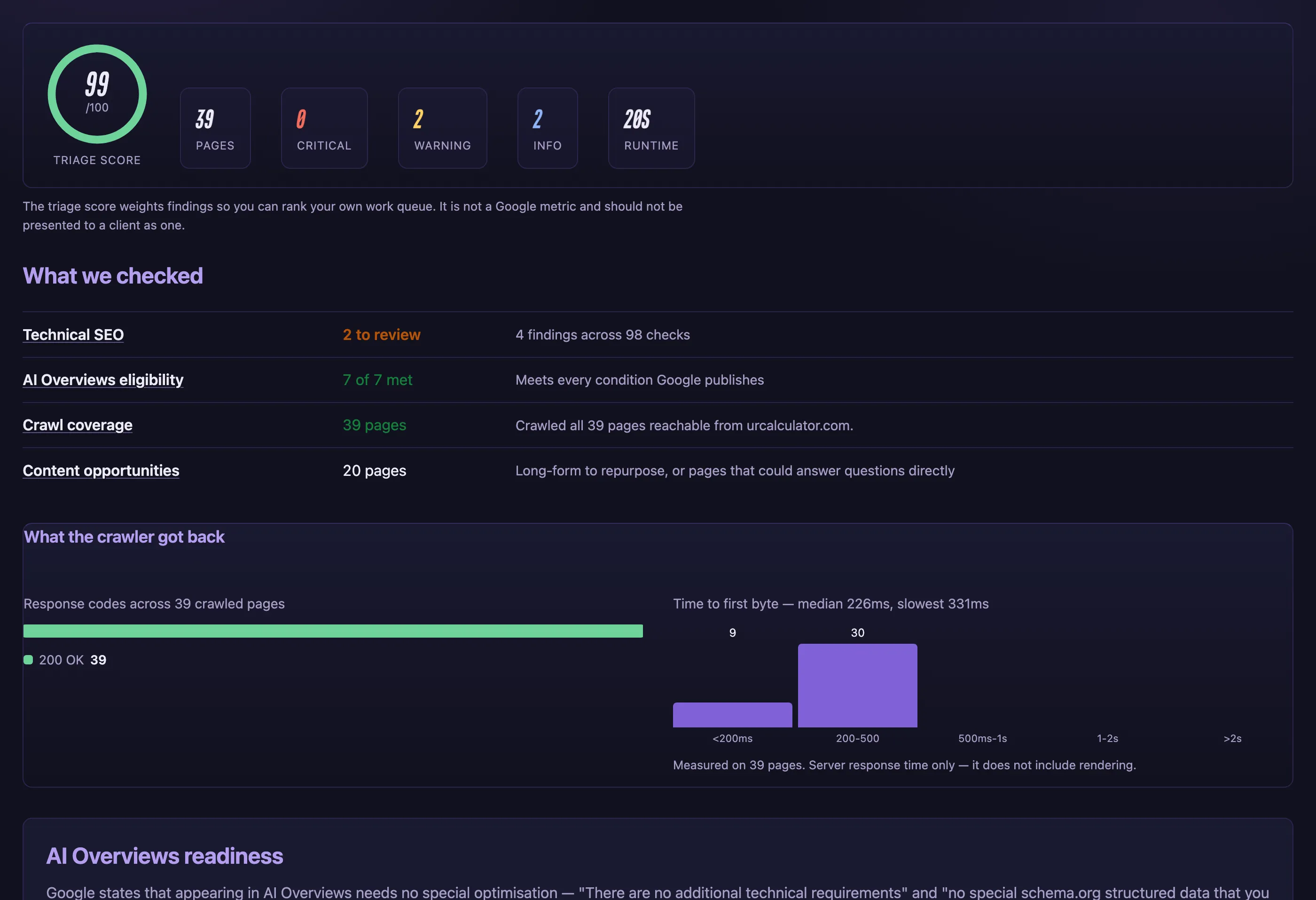
A list of specific, checkable problems with the addresses they were found on, ordered so you can tell the two that cost you traffic from the ninety that do not. Of the 101 checks, 22 are the ones we treat as critical.
How to make money from it
Traffic follows from being reachable, readable and trusted. Those are the conditions under which your content and your links can work at all, and they are the part you control completely. If you work for clients, the report is also the most credible first email you can send: "your product pages are asking Google not to index them, here are the eleven addresses" gets a reply in a way that "I can help with your SEO" does not.
Worth knowing. We do not predict rankings, and no honest tool does. What we can tell you is whether a search engine is able to see, read and trust each page. You cannot rank for something Google never indexed, so fixing this is necessary — it is not sufficient on its own.